
At iData Global, we believe that when we talk about AI governance, we are not only referring to rules or technical controls—we are talking about how technology aligns with values, ethics, and trust. In our experience, without robust architectures and adequate platforms, AI models can become fragile, opaque, or simply ineffective. Governing AI goes far beyond training models; it is about building infrastructures that enable traceability, automated audits, continuous monitoring, and constant adaptation.
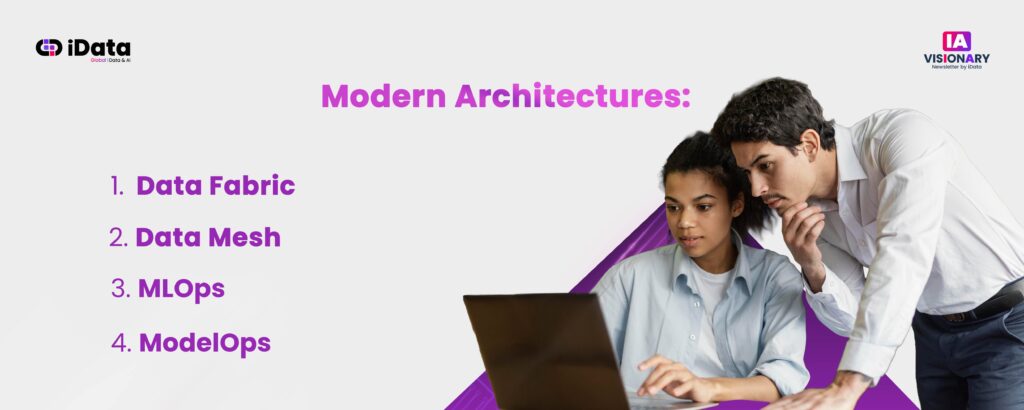
Modern Architectures: Data Fabric, Data Mesh, MLOps, and ModelOps
For governance to move from being a luxury to becoming an operational practice, it must rely on key technological architectures:
- Data Fabric: acts as a unified layer that integrates multiple data sources, automates pipelines, manages metadata and lineage, and enables secure and reliable access.
- Data Mesh: promotes decentralization of responsibility, where data domains are managed as products under a federated governance model. Gartner defines it as a sociotechnical shift that organizes data around domains, with teams managing products and adhering to shared standards.
- MLOps and ModelOps: automate the entire model lifecycle, from training to monitoring in production. Their value lies in the ability to version models, detect degradation, trigger retraining, and ensure compliance with both technical and regulatory standards.
These approaches are not mutually exclusive. In our experience, for global organizations—or those aspiring to become global—the combination of Data Fabric, Data Mesh, and MLOps/ModelOps forms the technological backbone of effective AI governance.
Automation, Audits, and Traceability
A governed architecture is not just about centralizing data—it requires automating best practices that close the accountability loop:
- Documenting lineage to trace the journey of every data point.
- Versioning models with clear metadata to compare iterations.
- Logging critical production decisions.
- Detecting bias or drift early, preventing models from losing reliability.
- Automatically auditing every deployment, with complete logs, performance metrics, and fairness checks.
At iData Global, we have confirmed that these capabilities are what make the difference between an isolated initiative and a sustainable strategy.
Statistics That Speak for Themselves
The evidence is clear:
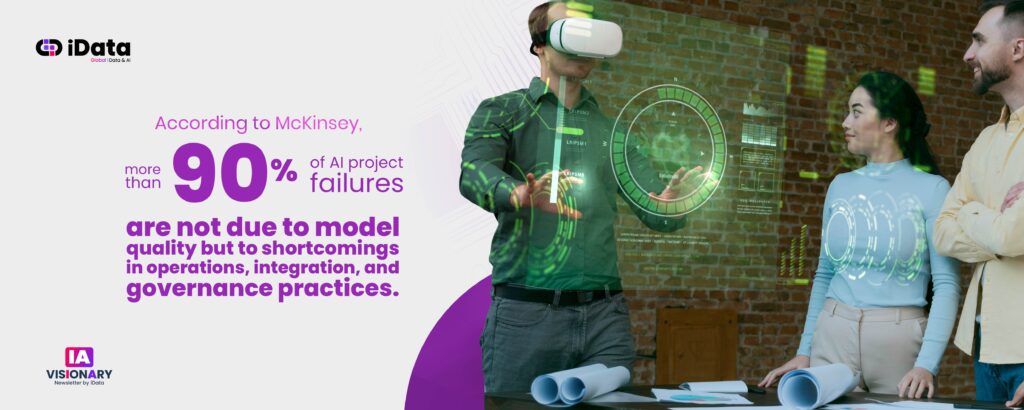
- According to McKinsey, more than 90% of AI project failures are not due to model quality but to shortcomings in operations, integration, and governance practices. This confirms that the real gap is not in data science, but in how models are managed in production.
- Gartner estimates that by 2026, 60% of companies will have adopted formal AI governance frameworks as a prerequisite for scaling their initiatives.
These figures reinforce what we see with our clients: the true bottleneck is not training—it is governance.
Document Search Modernization at PACTIA
A recent example is our work with PACTIA, an organization that sought to improve the management and access of its critical information. The challenge was to implement an intelligent cloud-based search system that would allow indexing, querying, and visualizing documents more efficiently.
The solution was designed on Microsoft Azure, leveraging Azure Cognitive Search and Azure OpenAI, which enabled:
- Centralizing documents and enabling natural language intelligent search.
- Ensuring traceability and access control in a trusted environment.
- Improving the search experience with faster and more relevant results.
- Scaling the solution without compromising performance, supporting a growing number of concurrent users.
The results were clear:
- Positive user adoption, with more than 70% of responses rated as useful.
- Usage metrics confirmed the scalability of the solution.
- Solid foundations for evolving toward advanced analytics and applied AI use cases.
This case reaffirms that governance does not begin when a model is already in production, but from the way we design the architecture that supports it. With PACTIA, the implementation not only solved a technological challenge but also aligned the organization with global standards in security, control, and traceability.
Implementation Challenges
Of course, these architectures are not without obstacles. Among the main challenges we have identified are:
- Technical complexity: integrating pipelines, ensuring lineage, and configuring robust alerts require significant investment in infrastructure and specialized talent.
- Organizational culture: governance must be embraced as part of daily operations, not perceived as an external imposition.
- Scalability and latency: supporting dozens of models and alerts without compromising performance remains a constant challenge.
- Cross-border regulatory compliance: operating in multiple countries requires adapting fairness, privacy, and user rights to different legal frameworks.

The Human Factor in the AI Journey
At iData Global, we believe that technology only makes sense when it serves people. Dignity, equity, and well-being must be the compass guiding every decision, because without empathy, even the most accurate model loses legitimacy.
We understand that AI governance architectures and platforms are not just technical components—they are the fabric that makes models trustworthy, ethical, and useful. By integrating Data Fabric, Data Mesh, and MLOps/ModelOps with continuous monitoring and automated audits, organizations can operate securely, scale with confidence, and manage risks with agility.

We invite you to join our upcoming Event on AI Governance Architectures and Platforms, where we will share technical insights, real-world case studies, and practical guides to help you build governance systems that truly drive results and put people at the center.