At iData Global, we’ve learned that data governance can no longer be understood merely as a compliance exercise or a set of mandatory controls. The future demands a paradigm shift: moving from viewing it as a regulatory requirement to embracing it as a strategic enabler—one that drives innovation, trust, and sustainable growth.
Today, business leaders face a complex reality: data volumes are growing exponentially, and the adoption of artificial intelligence models brings both opportunities and risks. In this landscape, governance is no longer just a safeguard—it becomes the framework that connects ROI, scalability, and competitive advantage.
Governance as the Engine of Trust and Scalability
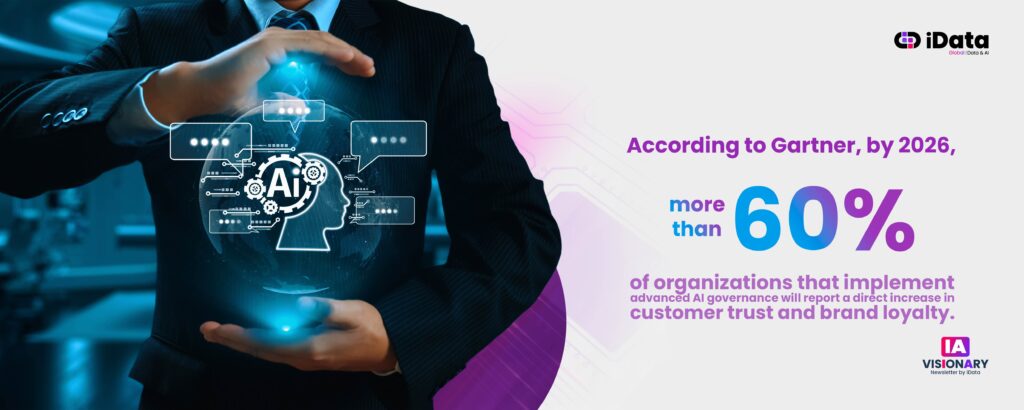
Trust is the most valuable currency in the digital economy. According to Gartner, by 2026 more than 60% of organizations that implement advanced AI governance will report a direct increase in customer trust and brand loyalty. This proves that governing data is not simply about “organizing” or “controlling” it, but ensuring every decision derived from it is traceable, auditable, and guided by ethics and transparency.
From our experience, AI scalability is impossible without a strong governance foundation. Autonomous algorithms learn, evolve, and in some cases make decisions in real time. Without policies, well-defined metadata, and clear lineage, the risks of bias and failure multiply. Governance becomes the invisible backbone that supports growth and enables organizations to scale with confidence.
Beyond Compliance: ROI and Competitive Advantage
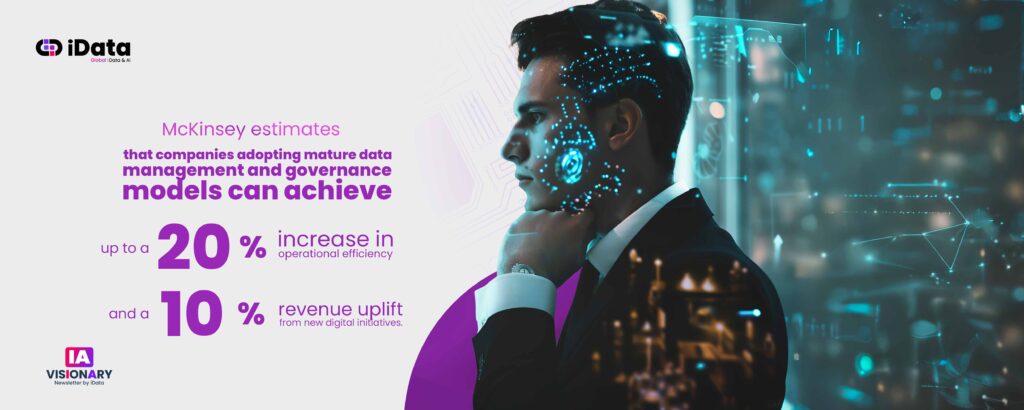
The real value of governance lies in the returns it generates. McKinsey estimates that companies adopting mature data management and governance models can achieve up to a 20% increase in operational efficiency and a 10% revenue uplift from new digital initiatives.
This means governance is no longer a cost or bureaucratic hurdle—it is an accelerator of innovation. Implemented strategically, it opens doors for AI experimentation, new business models, and real-time process optimization. In other words, governing with vision is investing in resilience and long-term competitiveness.
Case in Point: Universidad Mayor and Data Sovereignty
A clear example of this transition is our work with Universidad Mayor in Chile. Through a proof of concept with Microsoft Purview, we supported the institution in deploying its roadmap for data sovereignty. The project focused on integrating governance policies, lineage, roles, and the data lifecycle within a unified and scalable environment.
In just eight business days, the university was able to:
• Deploy Microsoft Purview within its Azure subscription.
• Connect and map critical data, classify it, and understand its information assets.
• Create column- and table-level metadata to strengthen traceability.
• Integrate glossaries, roles, workflows, and domains that laid the foundation for trusted management.
The impact was clear: the university not only strengthened compliance but also enabled an ecosystem prepared for advanced analytics and AI initiatives. This case illustrates how governance evolves from a requirement to a strategic asset that paves the way for innovation in education.
Future Vision: Toward Adaptive Governance
Artificial intelligence is advancing toward increasingly autonomous scenarios. Generative models, intelligent agents, and real-time decision systems demand adaptive governance—frameworks that evolve alongside technology. This is no longer about static policies, but about enabling flexible architectures that integrate Data Fabric, Data Mesh, MLOps, and ModelOps as pillars of scalability.
In this horizon, governance emerges as the mechanism that allows AI to operate responsibly without limiting its potential to innovate. It is living, dynamic governance—learning with the system and adapting to emerging risks. For organizations that aspire to lead, the key is to understand that governing is not about restriction, but about providing freedom with control and purpose.
How Urgent Is a Governance Plan for Your Organization?
A common question we hear is: “How do I know if I urgently need a governance strategy?” While every organization has its own context, some key indicators can help:
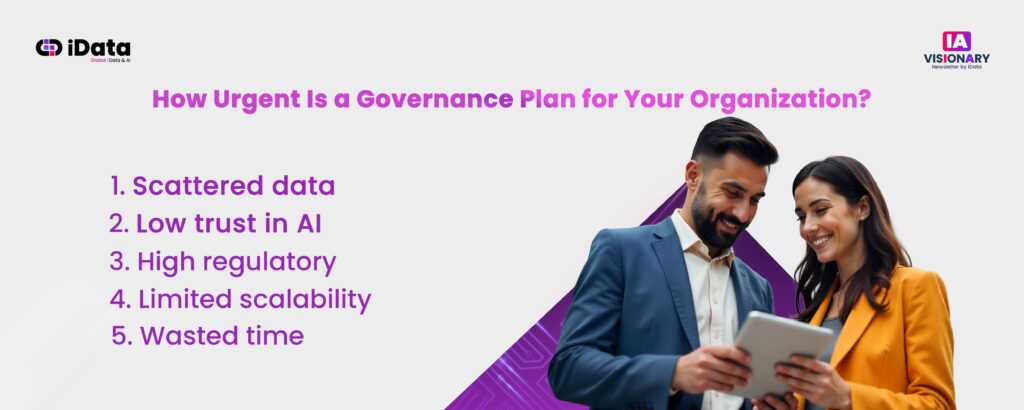
1. Scattered data – No clear inventory of data assets or lineage.
2. Low trust in AI – Models deliver inconsistent or inexplicable results.
3. High regulatory risk – Operating in highly supervised sectors (finance, healthcare, education) without clear controls.
4. Limited scalability – Analytics or AI projects fail to move beyond pilots due to lack of common standards.
5. Wasted time – Teams spend more time searching and cleaning data than creating value with it.
If one or more of these apply, the time to act is now. Governance is not a future project—it is a strategic necessity for today.
The Human Dimension: Balancing Technology and Organizational Health
Amid all this progress, we must not forget the human side of governance. At iData Global, we firmly believe that behind every algorithm and AI model are people who depend on its impact: patients, customers, citizens. The future of governance is also about protecting organizational and societal well-being—ensuring AI is applied ethically, inclusively, and responsibly.
Technology pushes us toward autonomous scenarios, but human judgment ensures every step has meaning. Striking that balance between AI and humanity is what will distinguish organizations that merely operate from those that truly transcend.
From Regulation to Strategy
The future of governance does not lie in rigid control, but in the strategic value it creates. It is the bridge that connects trust with innovation, efficiency with scalability, and compliance with competitive advantage. Most importantly, it is a journey we must take together—as organizations and as a society.
At iData Global, we are convinced this shift in vision is no longer optional. That is why we invite leaders and decision-makers to become active participants in this conversation.

Explore more in our virtual and in-person events, designed to share experiences, success stories, and trends in data governance and artificial intelligence.
Join our VIP event community and be part of building the future.