In a world where information has become the most valuable asset for organizations, digital trust has emerged as a new benchmark of competitiveness. Every decision, every predictive model, and every business strategy depend on one intangible yet essential factor: the assurance that data is reliable, protected, and ethically managed.
At iData Global, we understand this deeply. Our work goes beyond developing solutions powered by artificial intelligence or advanced analytics; it’s about ensuring that every byte of information has purpose, traceability, and security. It is at this intersection where data governance and cybersecurity converge—two disciplines that no longer operate in parallel but now complement each other to sustain the balance that defines digital trust.
The Strategic Convergence of Governance and Cybersecurity
For years, many organizations treated governance and cybersecurity as separate domains—one focused on compliance and data quality, the other on protection against external threats. Yet today’s landscape—shaped by distributed architectures, hybrid ecosystems, and generative AI models—demands a more integrated approach.
From our experience at iData Global, we’ve seen that true digital resilience emerges when both fronts operate under a unified strategy: the intelligent management of data risk and value.
Governance establishes the framework of policies, roles, and standards that ensure integrity, consistency, and responsible use of information. Cybersecurity, on the other hand, implements the technical, cryptographic, and operational controls that safeguard confidentiality, availability, and authenticity. When these functions align, organizations not only prevent incidents but also strengthen the trust of their teams, clients, and strategic partners.
From Control to Business Value
In this new paradigm, governance evolves from a control mechanism to a driver of business value. By defining clear guidelines on how data is created, classified, and consumed, organizations can apply risk-based security policies, prioritizing the most sensitive information and critical processes.
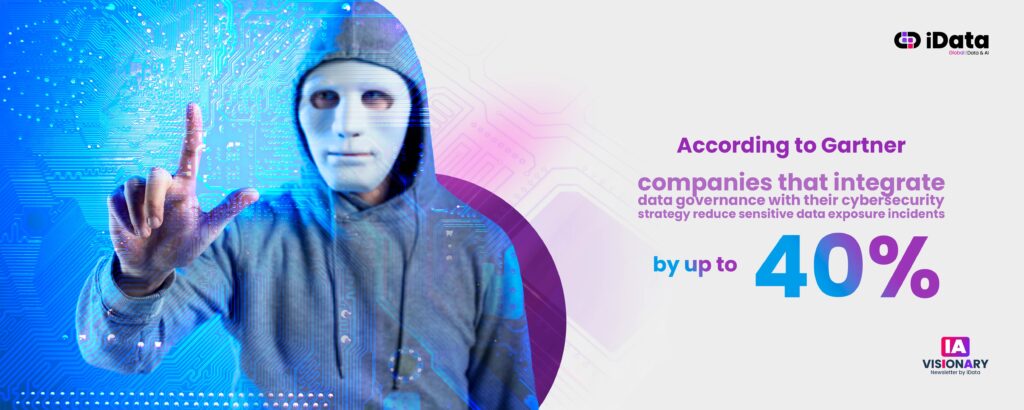
According to Gartner (2024), companies that integrate data governance with their cybersecurity strategy reduce sensitive data exposure incidents by up to 40%, and improve audit and compliance efficiency by up to 30%.
These numbers confirm what we witness every day at iData Global: when data policies and protection mechanisms operate in synergy, decision-making becomes faster, more reliable, and more strategic.
The Data Trust Framework: A New Common Ground
Today, digital transformation leaders understand that governance and cybersecurity are not isolated efforts but pillars of a single ecosystem. At iData Global, we promote the adoption of Data Trust Frameworks—structures that combine quality standards, access control, traceability, and continuous monitoring to ensure that every piece of data powering an AI model, financial application, or executive dashboard is trustworthy from its origin.
These trust frameworks establish a clear line between protected data and productive data—data that can safely be used to innovate. That’s where the real value lies: unlocking the potential of data without compromising security.
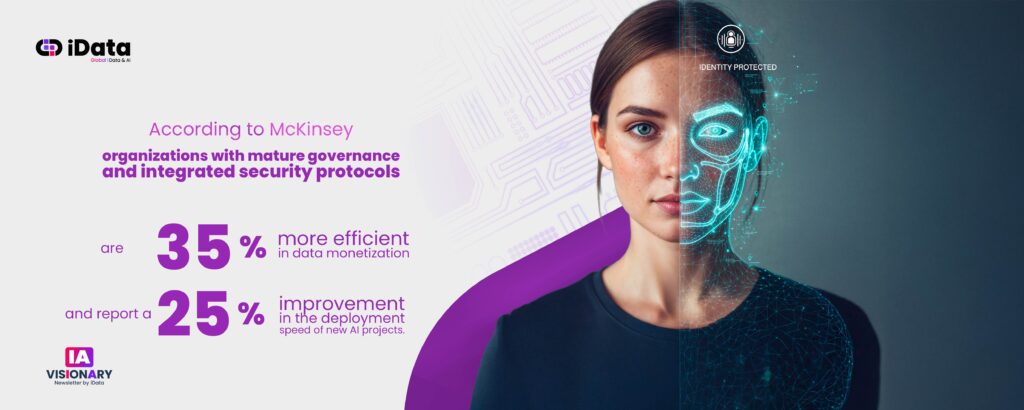
According to McKinsey (2025), organizations with mature governance and integrated security protocols are 35% more efficient in data monetization and report a 25% improvement in the deployment speed of new AI projects.
The result is a stronger, more predictable, and sustainable business model.
Governance as an Enabler of Proactive Security
Data governance not only defines who can access information, but also anticipates how that information should be protected. From data classification policies based on sensitivity to automated audits and traceability controls, governance acts as a proactive first line of defense.
At iData Global, we implement it as a core component of our data architectures. We believe that security doesn’t start with a firewall—it starts with a clear policy, well-managed metadata, and trained users who understand the value of data.
This perspective allows us to build operational trust environments, where cybersecurity is not merely a reaction to threats but an inherent capability by design.
Cybersecurity as the Guardian of Effective Governance
On the other side of the balance, cybersecurity validates the rules defined by governance. Without robust mechanisms for authentication, encryption, and access control, every data policy remains vulnerable.
That’s why cybersecurity not only protects information but also reinforces the authority of governance. Its role is to ensure that established principles—integrity, transparency, compliance—are effectively applied in every transaction, connection, or deployed analytical model.
Ultimately, both disciplines converge on a shared goal: building trust.
Trust that is measured not only in security metrics, but in the organization’s ability to operate with ethics, resilience, and predictability in increasingly complex environments.
Beyond the Technical: The Human Factor
In the balance between governance and cybersecurity, we must never forget the most important element: people.
Behind every protocol, every AI model, and every analytical dashboard, there are teams who interpret, decide, and act. Digital trust is not built by technology alone—it’s built through human judgment and organizational culture.
At iData Global, we believe that cybersecurity and governance are, above all, a reflection of values: integrity, transparency, and accountability. This connection between ethics and technology defines the future of business-driven artificial intelligence.
In sectors like healthcare—one of the most impacted by AI—proper data management and protection go beyond regulatory compliance; they represent a matter of humanity: protecting patient privacy, ensuring reliable diagnoses, and maintaining trust in systems that increasingly make decisions for us.
That’s why we insist that innovation must evolve at the same pace as awareness. Because without humanity, no algorithm holds true value.
The Path Toward Sustainable Digital Trust
At iData Global, we understand that integrating governance and cybersecurity is not a technical milestone—it’s an ongoing commitment to the future.
Every project, every implementation, and every model we build seeks to balance innovation with protection, speed with responsibility.
The outcome is not just a more secure ecosystem, but a culture where data becomes an ethical, intelligent, and sustainable asset that drives better decisions.
And while technology will continue to evolve, trust will always remain at the core—built through well-governed data, secure systems, and, above all, people committed to doing what’s right.
Join our upcoming webinar | Agentic AI: Transforming Cybersecurity in the Financial Industry
and discover how artificial intelligence is redefining digital protection through a new lens: trust