At iData Global, we have learned that data are not cold numbers. In reality, every data point is an opportunity to connect, understand, and transform human experiences. Today, we are experiencing a turning point where Artificial Intelligence (AI) has stopped being a support tool and has become the core of business strategy.
Hyper-personalization is no longer a futuristic vision; it is a current demand. People do not want to feel like part of a generic campaign: they expect to be recognized as unique individuals with their own stories, contexts, and needs. How do we respond to this at scale? With AI, real-time data, and deep digital empathy.
The Challenge: From Mass to Personal
For years, marketing and customer service operated under the logic of the “average segment.” But the era of “mass one-to-one” has arrived, and those responsible for growth—high-level strategists and visionary leaders—are already embracing it. Chief Marketing Officers (CMO) and Chief Customer Officers (CCO) are leading this transformation from the front.
Today, offering personalized experiences is no longer enough. The key lies in offering them with surgical precision and at a large scale, maintaining relevance without losing efficiency. This is only possible when AI and real-time data become strategic allies.

AI and Real-Time Data: The Engine of Hyper-personalization
The ability to adapt content, recommendations, and experiences based on what each customer needs at the precise moment is the differentiator. AI no longer simply predicts behaviors: it now interprets them in real-time and acts.
This is made possible by technologies such as Natural Language Processing (NLP), recommendation engines with deep learning, and cloud architectures that orchestrate frictionless data flows. But the true change occurs when these technologies are combined with a strategic, customer-centric vision.
One of our clients implemented an advanced decision engine solution to transform the credit analysis and approval process. JFK, a financial entity in Medellín, faced slow response times, manual processes, and disconnected data. With our help, we designed a system driven by AI and cloud architecture in Azure, which reduced credit analysis time from 3–5 days to less than 4 minutes.
This didn’t just streamline operations: it allowed JFK to handle more requests, personalize responses based on historical profiles, and generate a direct increase in disbursement indicators. Hyper-personalization didn’t stop at the message; it transformed the product.
The Strategic Role of CMOs and CCOs in the New Data Era
What we have observed across different industries is that personalization at scale is not a matter of software; it is a matter of leadership. Brand and experience leaders are no longer just at the end of the funnel: they are at the heart of the operation.
In organizations that adopt this real-time data culture, CMOs and CCOs become architects of automated experiences, ensuring consistency between the value promise and multi-channel execution.
Gartner projects that by 2026, more than 80% of customer-company interactions will be managed by autonomous AI systems with real-time feedback.
Who directs this symphony of personalization? Those leaders who understand that value lies not just in capturing data, but in converting it into precise, useful, and human decisions.
Cognitive Automation at the Service of Experience
Another of our clients used our capabilities to solve a challenge that directly touched the user experience: the National Insurance Institute (INS) in Costa Rica. Before our intervention, the processing of medical documents was manual, slow, and error-prone. This bottleneck impacted both operational efficiency and policyholder trust.
We designed and implemented a solution that combined automated document processing with Generative AI. More than 38 variables were extracted with an accuracy rate of over 90%, and the individual time dedicated to the process was reduced by 25% to 40%. Beyond the numbers, what changed was the perception of the final customer: the process was faster, more precise, and more human.
That is also hyper-personalization. Because by reducing errors, streamlining responses, and adapting the flow to real needs, a meaningful experience is built for each person, even in complex procedures.
From Knowledge to Understanding
Hyper-personalizing is not simply inserting the customer’s name into an email. It is about anticipating, adapting the content, channel, and timing of each interaction. It implies knowing not only what the customer did, but what they are about to do, and acting intelligently.
But that power requires responsibility. At iData Global, we believe that hyper-personalization only makes sense if it respects privacy, generates trust, and builds mutual value. Therefore, in addition to the technological infrastructure, we accompany our clients in defining ethical policies, governance best practices, and segmentation criteria that avoid bias or information overload.
Hyper-personalization is Scalable… if the Model is Right
One of the main fears we face in conversations with high-level leaders is: “Can this scale without losing control?” And the answer is yes, if done with the right foundations.
The secret lies in integration: from unified data architecture to automation flows connected to the core business systems. Only when marketing, operations, IT, and customer experience speak the same language is it possible to design personalized journeys in real-time.
The Experience Becomes the Product
More and more, we see that the true differentiator is not the physical or digital product we sell. It is the experience that surrounds it. And today, that experience is dynamic, predictive, and omnichannel. AI allows every touchpoint to be relevant, contextual, and emotionally resonant.
Human Judgment: An Irreplaceable Factor
We deeply believe that human judgment remains essential. No algorithm can replace the experience, intuition, and contextual sensitivity of the leaders who guide business decisions. At iData Global, we promote collaboration between technology and talent. AI makes better decisions when combined with the strategic direction of people who understand the complexity of the environment.
Tips for Leaders Wanting to Adopt Hyper-personalization
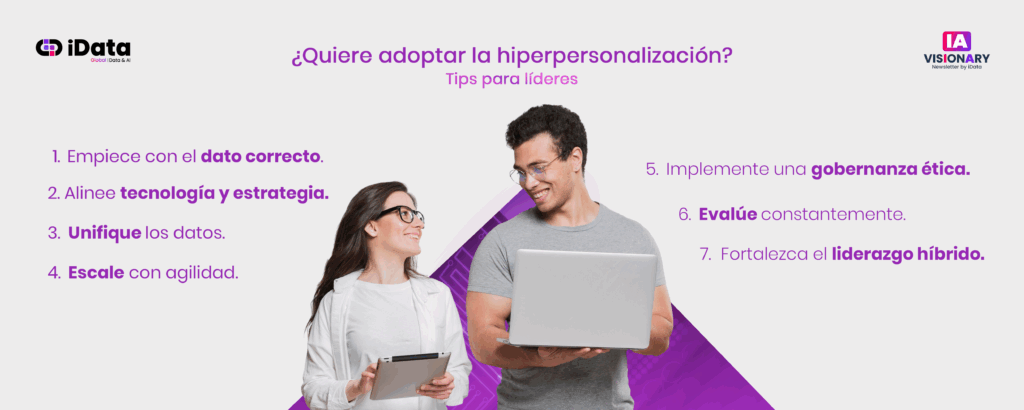
- Start with the right data. Prioritize quality over quantity.
- Align technology and strategy. Choose tools based on your business vision.
- Unify your data. Break down silos and create a single customer view.
- Scale with agility. Implement cloud solutions and modular platforms.
- Implement ethical governance. Protect privacy and avoid algorithmic bias.
- Evaluate constantly. Adjust and learn from every interaction.
- Strengthen hybrid leadership. Build teams that integrate human vision and analytical capability.
Data with Purpose, Technology with Soul In iData Global, we don’t just design solutions. We create experiences driven by data but built with humanity. Hyper-personalization at scale is not a task for algorithms alone. It is a strategic commitment that is born from a deep understanding of people.
If your organization is ready to take its relationship with customers to another level, work with a team that understands technology, respects the business, and never loses sight of the person. Let’s talk. At iData Global, we are ready to be your partner in intelligent evolution.